
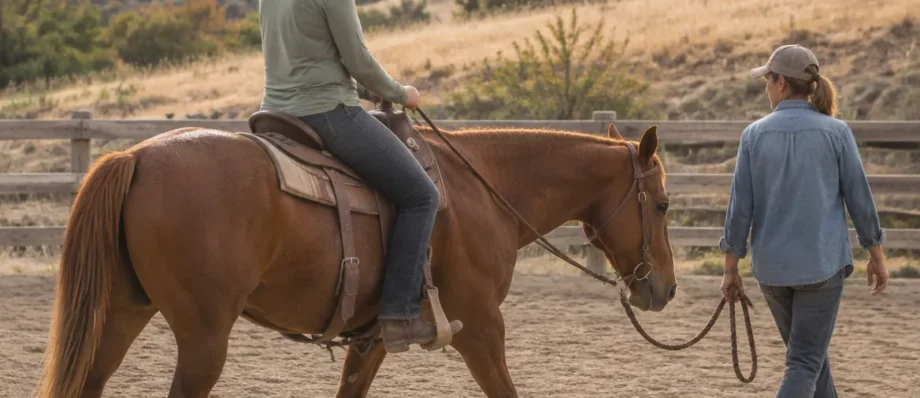
How to Start Western Riding as an Adult
You want to ride, but you may not know what to ask a barn, what to wear, or whether you will feel out of place among people who grew up with horses.
If you feel a little silly not knowing how to sit on a horse, that is something your first lesson should help you with. Your instructor should show you how to get on, where to place your feet, and how to sit while the horse stands and walks. You do not need to arrive knowing any of it.
The practical starting point is an introductory Western lesson with a qualified instructor on a horse suited to adult beginners. You can learn, make friends, and enjoy riding without buying a horse or deciding whether you ever want to compete.
At a glance
- Find a program that regularly teaches adult beginners and provides lesson horses.
- Ask to observe a lesson before committing to a package.
- Wear a properly fitted, certified equestrian helmet and suitable riding boots.
- Expect to learn horse handling, balance, stopping, and steering before adding speed.
- Measure progress by what you understand and can do with less help.
Decide what you want from riding
You do not need a detailed plan. A simple goal helps an instructor understand what matters to you.
Perhaps you want to enjoy guided trail rides, take a ranch vacation, learn ranch riding, or spend a regular evening around horses. Perhaps competition interests you. All are valid reasons to begin.
Western riding includes many activities, but the early foundation is shared: handling a horse safely, sitting in balance, and learning to communicate clearly. A Western saddle does not remove the need for those skills.
Tell the instructor both your goal and your main worry. “I would love to trail ride, but I am nervous about stopping” gives them something useful to work with.
Notice whether they ask follow-up questions. A good first conversation should help you feel understood and make the next step clearer.
Find a barn that welcomes adult beginners
Search for “adult beginner Western riding lessons” with your town or county. Read the lesson description carefully. A facility that trains horses or coaches experienced competitors may not offer instruction for someone starting from scratch.
Ask:
- Do you regularly teach adults who have never ridden?
- Do you provide horses suited to my experience, size, and needs?
- Who would teach me, and what experience do they have with adult beginners?
- Can I watch a beginner lesson?
- Does the lesson include grooming and learning to put on the equipment?
- What should I bring, what does it cost, and what is the cancellation policy?
The Certified Horsemanship Association recommends checking an instructor’s education and experience, verifying claimed certifications, and observing the program. Certification is a useful signal, alongside the quality of teaching you see. Ask about current liability insurance and emergency procedures, too. See the CHA instructor checklist, accessed October 29, 2026.
When you visit, watch how the instructor responds to confusion. Do they explain the task another way? Are they paying attention? Can the student ask for help without being embarrassed?
Look for an instructor who adjusts the lesson to the rider and horse. Be cautious if questions are brushed aside, helmets are discouraged, or beginners are pushed to continue when they feel unsafe.
A private introductory lesson may make it easier to ask questions and discuss nerves. A well-run beginner group can offer company and encouragement. Choose the setting where you receive enough attention to learn.
If the barn has no suitable horse or opening, ask for a referral. Availability is a practical constraint, not a judgment about whether you belong.
Buy the essentials and leave the rest for later
Ask the barn to confirm its requirements before shopping.
Helmet
Wear a properly fitted equestrian helmet whenever you ride. In the United States, look for SEI certification to the applicable ASTM equestrian helmet standard. Buy new so you know its history, and have a knowledgeable fitter help you. A bike helmet or cowboy hat is not a substitute. CHA explains both certification and fit in its rider safety apparel guide, accessed October 29, 2026.
If the barn supplies helmets, confirm that it has an appropriate size and that staff check fit and helmet condition before you mount. A helmet that happens to be available may not fit you.
Footwear
Choose riding boots with a defined heel and soles that will not catch in the stirrup. Ask your instructor to approve the boots and check their fit in the stirrups. Sneakers and heavy-tread hiking boots are poor choices. The British Horse Society explains why sole shape, heel, and stirrup clearance matter in its footwear guide, accessed October 29, 2026.
Clothing
Wear comfortable long pants that let you move and a top without loose, dangling parts. Check whether the barn recommends jeans or riding pants.
Leave the saddle, bridle, and training equipment to the lesson program. “Tack” means the equipment used on the horse, including the saddle and bridle. Your instructor should select and check it for the horse and help adjust it for you.
Plan a budget you can sustain
Ask for the total cost, not just the price beside “lesson.” Find out whether it includes the horse, equipment, preparation time, and any helmet rental. Check registration charges, package commitments, and missed-lesson rules.
For a local example, Silver Sage Equestrian in Farmington, Utah, listed a one-hour private Western lesson at $60 when checked on October 29, 2026. Its page also states that it provides lesson horses. This is one provider’s advertised price, not a Utah average or an endorsement; confirm current rates and availability directly. See Silver Sage lesson information.
Include travel and basic gear in your budget. Ask how much of the appointment is mounted riding and how much is horse preparation. Learning to groom and saddle is valuable instruction, but you should understand what you are paying for.
Choose a repeatable schedule with your instructor. Regular lessons give you a chance to revisit skills, but there is no need to buy a large package before you know whether the program fits.
Know what to expect at your first lesson
Tell the instructor your actual experience, even if that means you have only sat on a horse during a vacation. Mention relevant mobility needs, previous injuries, and worries before you mount.
A first lesson may include meeting your horse, learning where to stand, grooming with help, and watching the instructor check the tack. You may then practice mounting from a mounting block, a sturdy set of steps that helps you get into the saddle.
Once mounted, expect instruction on your position, how to hold the reins, and how to ask this horse to walk, stop, and turn. Your instructor may keep the horse on a lead while you become comfortable.
Ask for the stopping instructions before you move off. Let the instructor demonstrate and coach you; a written guide cannot tell you exactly how an unfamiliar horse has been trained.
You may spend the mounted portion at a walk. That gives you time to notice the movement under you and practice without adding more speed.
You may also use both hands on the reins. One-handed riding is not a first-lesson requirement. Follow your instructor’s guidance for the horse and equipment.
Before leaving, ask what you worked on and what comes next. You should be able to name something you understand better, even if it still feels awkward.
Learn to work with the horse on the ground
“Groundwork” means working with a horse while you are not riding. For a beginner, this can include approaching, leading, grooming, and learning where to stand under supervision.
Ask your instructor to show you how to hold the lead rope and move around the horse safely. Do not wrap a rope or reins around your hand or body. Stay with the tasks you have been taught, with help available.
These moments are part of learning to ride. They let you notice how your movement affects the horse before you add the demands of sitting in the saddle.
For example, if the horse moves away during grooming or becomes tense when the saddle is placed, tell the instructor. You do not have to diagnose the cause. Discomfort, confusion, training, and the surroundings may all matter. For suspected pain or lameness, ask your veterinarian; at a lesson barn, alert the instructor so they can arrange appropriate care.
Your job is to learn on a suitable horse with guidance. Training an inexperienced or frightened horse requires skills you are still developing.
Work with nerves in small steps
Fear gives your instructor information. Name the part that worries you: getting on, being high above the ground, losing balance, or being unable to stop.
Ask to break that task down. You might first watch the mounting process, then practice mounting with assistance, sit while the horse stands, and walk when you and the instructor are ready.
Notice whether you can still listen and follow directions. If you are overwhelmed, say so and ask the instructor to help you pause or finish safely.
A patient instructor can help you meet manageable challenges without rushing. They should also reassess the horse, equipment, and setting when those are contributing to your worry.
Riding carries a risk of injury even with good preparation. If a health condition or recent injury may affect your participation, discuss riding with your healthcare professional. After a fall, injury assessment comes before any decision to remount; suspected concussion needs medical assessment. The University of Kentucky’s Saddle Up Safely return-to-riding guide covers these precautions.
Build a foundation without rushing the timeline
Some trainers teach through a consistent sequence of repeated exercises. Others favor fewer repetitions and more adjustment to how the horse responds.
Both approaches raise a useful question:
Is this practice helping the rider and horse understand?
As a beginner, you need a clear routine. Repeating a walk, turn, and halt exercise can help you learn the order of your actions. But if you become tired or confused, or the horse becomes tense, more repetition is not automatically better. Your instructor should simplify, pause, or change the task.
Use a clear progression with a flexible pace. Learn to stay balanced, follow directions, and control the horse at the current level before adding another challenge.
You will hear “jog” for a slow Western trot and “lope” for the Western canter. Neither belongs on a deadline. Ask what skills your instructor wants to see before introducing them.
After a lesson, write down what became easier, what still confused you, and what you want to ask next time. Progress might mean stopping with less help, recognizing when you have lost your balance, or remembering a handling routine.
Trail riding, recreation, and competition can all be satisfying goals. Faster riding and ribbons are not the only ways to improve.
Take your next step close to home
Start with a nearby program you can realistically visit. For Utah riders, use Start Western Riding’s directory to look for lesson providers, then confirm that they teach adult beginners and supply suitable horses.
You can use this message:
Hello, I’m an adult interested in learning Western riding, and I’m starting from the beginning. Do you teach adult beginners on your lesson horses? I’d like to learn safe horse handling as well as riding. Could I watch a lesson or book an introductory session? Please let me know the cost, what to wear, and what to expect.
If the first program is full, request a referral or a place on its waiting list. If the teaching style does not suit you, trying another instructor is reasonable.
Look for opportunities to meet other adult students, too. A barn where you can ask a question and share a small success can make it easier to keep showing up.
Frequently asked questions
Am I too old to start Western riding?
Being an adult is not, by itself, a reason to rule it out. The practical questions are whether the program has a suitable horse, appropriate instruction, and support for your needs. Discuss relevant health concerns with your healthcare professional rather than relying on a blanket age rule.
Do I need to own a horse?
No. Look for a program that supplies lesson horses. You can continue taking lessons without becoming an owner. Leasing or buying can be a later decision, made with experienced help and a clear understanding of the responsibilities.
Do I need to be fit or a certain size?
Tell the program about your needs before booking. Ask about rider limits, available horses, saddle fit, mounting assistance, and adaptive instruction where relevant. A barn’s capacity depends on its horses, equipment, and staff. It should explain its limits respectfully and clearly.
Is Western riding easier than English riding?
Both require balance, timing, and clear communication. Choose Western because it interests you, while putting the quality of instruction and the suitability of the horse first. A larger saddle does not make an unsuitable horse appropriate for a beginner.
Can I start with a trail ride?
A guided beginner trail ride can be an introduction if the provider accepts first-time riders and has appropriate horses and supervision. Tell them your experience honestly. For ongoing learning, choose lessons that teach you to stop, steer, and handle the horse, then ask your instructor when a trail outing fits your skills.